The Book of Enoch unveils a tapestry of divine revelation, weaving prophecy, morality, and cosmology.
Following the Book of Watchers (chapters 1–36) and the Book of Parables (chapters 37–71), the Astronomical Book (chapters 72–82), also called the Book of the Luminaries, presents Enoch’s angelic-guided exploration of the cosmos – sun, moon, stars, and seasons.
Revealed by the angel Uriel, this section, likely composed between the 3rd and 2nd centuries BCE, underscores creation’s harmonious order as a model for human righteousness.
For spiritual seekers, scholars, or those intrigued by ancient wisdom, the Astronomical Book offers a profound reflection on divine design and human responsibility. This article explores its themes, structure, and interpretations, inviting readers to deepen their understanding—perhaps through an e-book to navigate its celestial insights.
Historical and Literary Context
The Astronomical Book is among the earliest sections of the Book of Enoch, predating the Book of Parables and possibly contemporary with the Book of Watchers. Composed in Aramaic, it survives in Ethiopic (Ge’ez) and fragmentary Aramaic texts from Qumran, dated to the 3rd–2nd centuries BCE.
Unlike the narrative-driven Book of Watchers, it adopts a scientific tone, detailing celestial mechanics in a Jewish context shaped by Babylonian and Hellenistic astronomy.
Addressed to Enoch’s son Methuselah and future generations (76:14; 79:1), it reflects a community seeking to align with divine law amid cultural shifts. Its emphasis on a 364-day solar calendar, distinct from the lunar calendars of some Jewish groups, suggests a polemic against rival priestly traditions.
This context positions the Astronomical Book as both a cosmological treatise and a call to fidelity to God’s order.
Chapters 72–75: The Sun’s Path and Cosmic Gates

Chapters 72–75 introduce the Astronomical Book’s core focus: the sun’s orderly movement, guided by Uriel, as a testament to divine precision.
Chapter 72 describes the sun’s annual journey through six eastern and six western “gates” or portals, rising and setting in specific positions to mark seasons. Each gate corresponds to a month, with the sun’s light increasing or decreasing to regulate day length. This 364-day solar calendar, divisible by weeks, aligns with Jewish festivals like the Sabbath, contrasting with the 354-day lunar calendar.
Chapter 73 shifts to the moon, which also traverses the gates but with varying cycles, its light waxing and waning over 29–30 days.
Chapter 74 compares the solar and lunar years, noting their divergence and the need for intercalation to align them.
Chapter 75 explains the “chariots” of the sun and moon, guided by angels, ensuring their paths never falter. The text emphasizes that these luminaries obey God’s command, unlike the fallen angels of the Book of Watchers.
Scholars interpret this as a theological statement: the cosmos’ regularity reflects divine sovereignty, urging humans to emulate this obedience. The 364-day calendar, also found in Jubilees and Qumran texts, likely served to unify a sect’s worship practices, distinguishing them from Temple authorities using lunar reckoning.
Modern parallels emerge in debates over standardized timekeeping or environmental stewardship, where order reflects respect for creation.
Chapters 76–77: Winds, Seasons, and Earth’s Divisions

Chapters 76–77 expand the cosmic framework to include winds, seasons, and earth’s geography.
Chapter 76 details twelve “portals” at the earth’s edges—three per cardinal direction (east, west, north, south)—through which winds emerge to influence weather. Beneficial winds bring rain, while harmful ones cause drought or storms, all under divine control. These portals echo the sun’s gates, reinforcing the text’s theme of structured creation.
Chapter 77 divides the earth into regions, describing three zones: one for humans, one for the dead, and a paradisiacal garden for the righteous. It also mentions seven mountains, rivers, and seas, possibly reflecting Babylonian world maps. The chapter’s brevity belies its significance: by mapping the earth, Enoch asserts God’s dominion over all realms, from the living to the afterlife.
Interpretations highlight the text’s dual purpose. Theologically, it presents creation as a divine blueprint, with winds and seasons as witnesses to God’s law, akin to the Book of Watchers’ obedient stars. Practically, it may have guided agricultural and liturgical cycles for a community tied to the 364-day calendar.
Today, this resonates with efforts to understand climate systems or preserve natural rhythms, reminding us of our role in sustaining creation’s balance. An e-book can offer tools to explore these ancient insights in a modern context.
Chapters 78–79: Lunar Cycles and Celestial Harmony

Chapters 78–79 delve deeper into the moon’s cycles, complementing the sun’s dominance.
Chapter 78 describes the moon’s phases—waxing to full, waning to new—through the same gates as the sun, with precise measurements of its light. It notes the moon’s names, “Asenya” and “Lebna,” possibly reflecting cultural variations.
Chapter 79 summarizes the luminaries’ laws, with Uriel instructing Enoch to record them for future generations. The chapter emphasizes that these laws are eternal, unchanging despite human error.
Scholars see this as a corrective to lunar-based calendars, which the text implicitly critiques for misaligning with God’s design. The moon’s subordination to the sun underscores the solar calendar’s primacy, a point of contention in Second Temple Judaism.
Theologically, the luminaries’ harmony mirrors the righteousness Enoch advocates, contrasting with the Book of Watchers’ rebellious angels.
In a modern lens, this evokes discussions on scientific accuracy versus cultural tradition, or the need for systems—be it timekeeping or ethics—that align with observable truth.
Chapters 80–82: Corruption, Restoration, and Enoch’s Charge
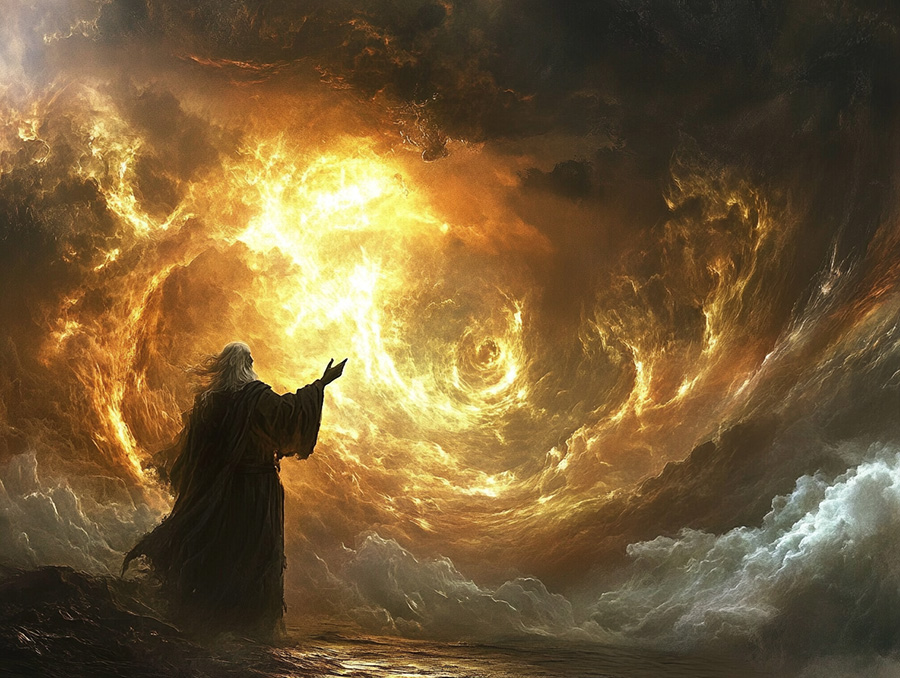
Chapters 80–82 conclude the Astronomical Book with a shift from description to prophecy. Chapter 80 warns that in “those days” (an apocalyptic future), cosmic order will falter due to human sin: stars will stray, seasons will shift, and rains will fail. This disruption, linked to the Book of Watchers’ theme of rebellion, underscores that human actions impact creation’s harmony. Yet hope remains: God’s laws endure, and the righteous will discern truth.
Chapter 81 transitions to Enoch’s role. Angels show him the “heavenly tablets,” recording human deeds, and instruct him to teach his children. The righteous will be rewarded, the wicked judged, tying the Astronomical Book to the Book of Parables’ eschatology.
Chapter 82 reinforces the solar calendar, detailing the four epagomenal days (extra days to reach 364) and the angels overseeing seasons . Enoch passes this knowledge to Methuselah, ensuring its transmission.
Interpretations view chapter 80’s cosmic upheaval as a metaphor for moral decay, with environmental parallels today—climate change, deforestation, or pollution reflecting human disregard for natural order.
Chapter 81’s tablets echo ancient Near Eastern concepts of divine records, emphasizing accountability, a theme resonant in discussions of ethical responsibility. Chapter 82’s calendar reinforces the text’s practical aim: to guide a community’s worship and agriculture. The Book of Enoch can further illuminate these connections, offering insights for living in sync with divine and natural rhythms.
Invitation to Explore
The Astronomical Book speaks to contemporary concerns with striking clarity. Its vision of a cosmos governed by divine law challenges us to respect creation’s rhythms, from sustainable practices to ethical systems.
The 364-day calendar, though outdated, reflects a commitment to truth over tradition, echoing debates over science and belief.
Enoch’s role as a teacher underscores the value of sharing wisdom, a call relevant in an era of information overload. As one scholar notes, “Enoch’s cosmos reminds us that order begins with obedience – to God, to nature, to truth.”
Whether drawn to the sun’s gates, the moon’s cycles, or the promise of restoration, the Astronomical Book invites readers to align with a universe crafted by divine wisdom and sustained by human fidelity.