Following the Book of Watchers (chapters 1–36), the Book of Parables (chapters 37–71) shifts focus to a Messianic figure, divine judgment, and the ultimate triumph of righteousness.
Likely composed between the 1st century BCE and 1st century CE, this section offers a hopeful yet sobering vision of cosmic restoration. For those exploring ancient wisdom or seeking spiritual insight, the Book of Parables provides an ancient view on justice, redemption, and humanity’s destiny.
Historical and Literary Context
The Book of Parables emerged in a period of Jewish ferment, possibly between 40 BCE and 70 CE, amid Roman occupation and messianic expectations.
Unlike the Book of Watchers, it survives only in the Ethiopic (Ge’ez) version of the Book of Enoch, with no complete Aramaic or Greek texts. Its absence from the Qumran scrolls suggests a later composition, possibly by a Jewish group influenced by apocalyptic thought.
The text builds on the Book of Watchers’ themes of divine justice but introduces a distinct Messianic figure, often called the “Son of Man,” echoing Daniel 7:13–14.
Addressed to a community yearning for deliverance, it blends Jewish theology with Hellenistic and Persian cosmological ideas, offering hope in a world of oppression. This context frames the Book of Parables as a theological response to suffering and a blueprint for divine victory.
Chapters 37 – 44: Enoch’s Vision and the Heavenly Order
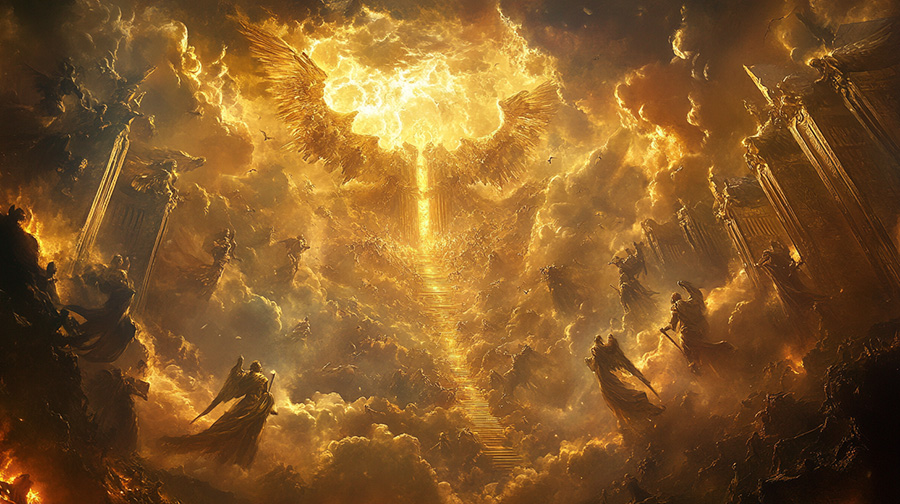
The Book of Parables opens with Enoch’s second vision, introduced in chapter 37 as a revelation of “wisdom” for the righteous.
Unlike the Book of Watchers’ focus on angelic rebellion, here Enoch ascends to heavenly realms to witness God’s throne and the cosmic order.
The “Righteous One” and “Elect One,” titles for a Messianic figure, appear, promising judgment on the wicked and salvation for the faithful.
Chapter 39 describes Enoch’s awe before the “Head of Days” (God), surrounded by angels and the righteous dwelling in celestial homes.
Chapters 40–44 explore heaven’s mechanics. Four archangels – Michael, Raphael, Gabriel, and Phanuel – serve distinct roles, from guarding Israel to recording deeds.
Chapter 41 reveals “storehouses” of celestial phenomena stars, thunder, light – operating under divine command , echoing the Book of Watchers’ emphasis on creation’s obedience.
Chapter 43 introduces stars and spirits aligned with the righteous, symbolizing cosmic harmony. Scholars interpret this as a theological map, assuring readers that God’s plan governs both heaven and earth.
The Messianic figure’s prominence, unique in Enochic literature, suggests influence from Daniel and anticipates Christian Christology, though rooted in Jewish eschatology.
Chapters 45–57: The Son of Man and Final Judgment
Chapters 45–57 center on the “Son of Man,” a title drawn from Daniel 7:13, who embodies divine authority and Messianic hope.
Chapter 45 depicts God’s judgment: the wicked are banished, while the righteous inherit a transformed earth. The Son of Man, also called the “Elect One” and “Anointed One,” is pre-existent, chosen before creation, and tasked with executing justice. His identity – distinct from Enoch himself – sparks debate. Some scholars see him as a transcendent figure, others as a collective symbol for Israel. His role as judge and redeemer, revealing hidden wisdom, aligns with Isaiah 11’s Messianic prophecies.
Chapters 50–57 detail the judgment’s scope. The righteous receive mercy, sinners face torment, and nations bow to the Elect One.
Chapter 55 introduces Noah’s flood as a precursor to this final reckoning, linking the Book of Parables to the Book of Watchers. The “kings and mighty ones” (likely Roman or local elites) are singled out for their oppression, their wealth futile against divine wrath.
Chapter 56 envisions angelic armies and resurrected martyrs, reinforcing hope for the persecuted.
Interpretations vary: some view the Son of Man as a precursor to Jesus, while others emphasize his Jewish context as a divine agent. The text’s focus on justice resonates with modern calls for accountability, from systemic inequality to environmental neglect. An e-book can guide readers in applying these principles to contemporary challenges.
Chapters 58–69: Rewards, Punishments, and Cosmic Secrets

Chapters 58–69 elaborate on the fates of the righteous and wicked, interwoven with cosmological revelations. Chapter 58 promises the righteous eternal life and “light,” echoing Daniel 12:3. By contrast, chapters 63–64 depict the mighty pleading for mercy but receiving none, their pride exposed.
The fallen angels from the Book of Watchers reappear, with Azazel and others bound in a fiery abyss for their rebellion.
Chapter 65 links their sin to Noah’s flood, portraying it as a divine cleansing, while chapter 69 lists angelic names and their illicit teachings, reinforcing the Book of Watchers’ warnings about forbidden knowledge.
Cosmological interludes add depth. Chapter 59 describes “secrets of the winds” and lightning, governed by divine order.
Chapter 60 introduces a “beast” and “Leviathan,” symbolizing chaos tamed by God, alongside precise measurements of creation.
Scholars see these as a blend of Jewish and Persian dualism, emphasizing God’s sovereignty over chaos. The righteous’ reward – eternal communion with the Son of Man – offers hope, while the wicked’s punishment underscores accountability. This duality speaks to modern tensions: technology’s promise versus its perils, or justice versus corruption.
Chapters 70–71: Enoch’s Ascent and the Son of Man Debate
The Book of Parables concludes with chapters 70–71, where Enoch’s role and the Son of Man’s identity converge.
Chapter 70 describes Enoch’s final ascent to heaven, where he dwells among angels.
Chapter 71, however, complicates matters: Enoch is seemingly identified as the Son of Man, seated on a throne of glory. This has sparked scholarly debate. Some argue it’s a later addition, inconsistent with earlier chapters where the Son of Man is distinct. Others suggest Enoch’s transformation symbolizes the righteous’ ultimate exaltation, not a literal equation with the Messiah.
Interpretations hinge on context. In Jewish thought, the Son of Man is a divine agent, not necessarily human, aligning with Daniel’s vision. Early Christians, however, saw parallels to Jesus’ self-description (e.g., Mark 13:26). The text’s ambiguity invites reflection: is the Son of Man a person, a role, or a collective ideal?
Chapter 71’s cosmic imagery – Enoch beholding the “Head of Days” and creation’s secrets – reinforces the Book of Parables’ theme of divine wisdom revealed to the faithful.
This section challenges readers to consider their own potential for transformation, a theme resonant in personal growth and spiritual journeys today.
Invitation to Explore
The Book of Parables speaks powerfully to contemporary concerns. Its vision of a Messianic judge confronting the “kings and mighty ones” echoes calls for justice in an era of inequality and power abuses.
The Son of Man’s role as revealer of wisdom invites reflection on truth in a world of misinformation. The text’s hope – a transformed earth where the righteous dwell in light – offers solace amid global challenges, from climate crises to social unrest. As one commentator notes, “Enoch’s parables remind us that justice, though delayed, is certain, and hope is eternal.”
For those drawn to its Messianic vision or cosmic scope, an e-book on the Book of Enoch can serve as a guide, illuminating its narratives and connecting its insights to modern life.
Whether exploring the Son of Man’s identity, the fate of the wicked, or the promise of renewal, the Book of Parables invites readers to ponder their role in a universe shaped by divine purpose and accountability.